
italy.png
Beta
  
YearEventEdit
2020

Beta Argentina begins assembling Zontes models at its own plant in Tigre. This makes Argentina the first country outside China to receive authorization to assemble Zontes products.

2018

Beta Motor de Argentina becomes the exclusive distributor for TVS Motor Company (India) and Zontes (Guangdong Tayo Motorcycles) in Argentina.

Beta is bringing a 125cc 2-stroke back onto the market for the first time with the RR 125. With an engine developed in-house.

2009

Beta presented its first large four-stroke engine.

2007

Beta USA, Inc. is founded in Paso Robles, California.

2006

Beta Motor Japan is founded in Toyama, Japan. Junichi Kadota is at the helm. Wise Motocross was already operating as a specialist off-road shop and technical service provider before the company was officially established. Beta Motor Japan now takes on the role of general importer, while Wise Motocross continues to function as the operational arm for racing services and end customer support.

2005

Market launch of the first Beta RR 400, 450, and 525. These used the KTM RFS (Racing Four Stroke) engine.

2004

Beta returns to the four-stroke enduro sector with a significant investment in product development and racing presence.

1998

Betamotor Deutschland GmbH is founded in Schönbrunn (BW).

1996

Market launch of the Beta 50cc RK 6 (Racing KTM 6-Gear) models

1995

Beta Motor de Argentina S.A. is founded as a joint venture in Tigre (Buenos Aires province), Argentina. Beta Motor de Argentina has its own production facility. Specific models for the Latin American market are assembled there (CKD - Completely Knocked Down) in order to comply with local import regulations and keep prices competitive. In addition to Italian competitor models (enduro/trial), the joint venture also produces and distributes its own scooter and city motorcycle models under the Beta name, which are specially tailored to the South American market. Lino Stefanuto is the Argentine partner and co-founder. Stefanuto also serves as president of Beta Motor de Argentina and is a central figure in the Argentine motorcycle industry (including as president of CAFAM, the Argentine Chamber of Motorcycle Manufacturers).

Beta signs a cooperation agreement with KTM to build 50cc engines. Beta needs a modern engine to compete with Minarelli AM6. KTM had developed an excellent 50cc engine, but did not have the necessary free assembly capacity in Mattighofen for the planned quantities for children's motocross bikes. Beta is to build the engines for both its own and KTM models. This gives Beta insight into KTM's manufacturing processes.

1994

Beta-France SARL is founded in Paris. The previous French importer, SIMA, had only taken over the import of Husqvarna to France a year earlier.

1991

With the MX50, Beta is launching a 50cc enduro model for the first time in years. The engine is the result of a collaboration with Morini.

1987

Jordi Tarrés becomes world champion on a Beta Trial. This is the first world championship title for Beta.

1979

Beta launches activities in trial sports

1978
Jahresereignis
Campionato italiano 125ccm Cross

Corrado Maddi achieves Beta's last major success in motocross for the time being by winning the Italian vice-championship.

WM 125ccm Cross

Corrado Maddi Beta takes 10th place in the World Championship

1976
Campionato italiano 125ccm Cross

A very strong year for Beta: Paolo Piron wins the national 125cc title.

Jahresereignis
Campionato italiano 250ccm Cross

Ivano Bessone completes a perfect Beta year by winning the Italian 250cc class title.

Ivano Bessone completes the podium for Beta in the newly created 125cc class.

WM

Third place in the second race at the season opener in Austria caught people's attention. But Bessone and Beta were unable to repeat this performance over the course of the season.

1973

Beta launches its own line of engines for sporting use so that it is no longer dependent on suppliers.

Specialization in off-road (1970s & 1980s)

In the 1970s, Beta made the strategic decision to turn away from the mass market for road motorcycles and specialize in off-road sports.

From around 1972/73, Beta launched its own line of engines for sporting use so that it would no longer be dependent on suppliers.

  • Focus on trials: In the 1980s, Beta became the dominant force in trials racing.
  • Legends: Riders such as Jordi Tarrés won a string of world championship titles on Beta (1987, 1989, 1990, 1991). The Beta Zero model (with the first aluminum bridge frame in trials) set new technological standards.
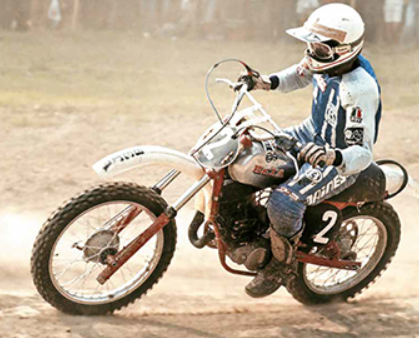
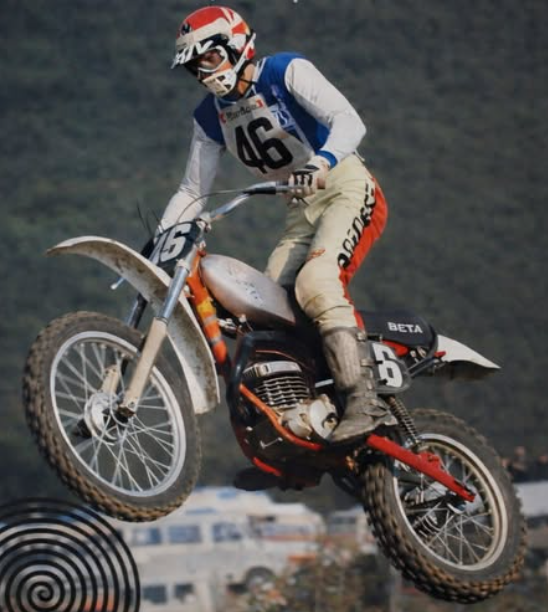
  • The most famous names in motocross who were successful on a Beta were American Jim Pomeroy, Belgian Gilbert De Roover, and Italian Ivano Bessone. Fifteen-time Italian motocross champion Corrado Maddii began his racing career in 1977 on a Beta 125RC. 
  • However, the focus on trials meant that in the early 1980s, development in enduro and motocross lagged noticeably behind the competition. The first 125cc MX model with water cooling, for example, did not appear until 1981 and was not a real new development, but merely a cylinder variant. The aluminum swingarm did not appear until 1982.

Engine collaborations

Beta used Morini engines primarily when it came to cost-effective large-scale production technology for the "utility" sector or special children's vehicles:

  • Beta mopeds (1970s/1980s) and children's motocross bikes (Bambino) sometimes used Franco Morini engines.
  • In the early 1990s, Beta began using the air-cooled engines of the Suzuki DR series for its new concepts. Between 2000 and 2015, Suzuki engines were at the heart of the popular Alp series (Alp 200 and Alp 4.0). With the introduction of the Euro 4 emissions standard, the last models with the old Suzuki designs were phased out. Instead, these engines are now produced with a Chinese partner.
  • The KTM phase (2004–2009): When Beta re-entered the sporty enduro market (hard enduro), they used KTM's proven RFS engines. This gave the brand an enormous boost in terms of quality and image.

Independence and the modern era (from around 2010)

The most important step in the company's recent history was the move away from third-party engines. Since 2010, Beta has been building most of its own 4-stroke and 2-stroke engines in Rignano sull'Arno (near Florence).

Last edited: 2/20/2026 · Jürgen Wißler