
| Year | Event | Edit | ||
|---|---|---|---|---|
| 2017 | Sylvain Geboers officially steps down from his role as team manager after Suzuki announced its withdrawal from competitive motocross racing. | |||
| 2010 | Roger de Coster's contract with Suzuki is expiring. When he asks for a meeting with Suzuki management, they refer him to Yoshimura, the tuning partner that co-operates the team. De Coster feels this is a demotion, as he works for Suzuki and not for Yoshimura. Due to the economic crisis at the time, Suzuki is acting extremely cautiously in Japan and the US and only offers him a one-year contract extension. But de Coster wants security and a budget to remain competitive in the long term. Suzuki, however, refuses to make any long-term commitments. | |||
| 2008 | Suzuki discontinued the development and sale of the two-stroke models in the RM series in order to focus entirely on the RM-Z four-stroke models (RM-Z 250 and RM-Z 450). Remaining stock was sold off in some markets until 2009/2010, but the 2008 model year marks the technical end of the line. | |||
| 1999 | US Nationals Five years after winning the 250cc world championship title and subsequently moving to America, Greg Alberty has finally made it here too. He became the Suzuki US champion in the outdoors. | |||
| 1995 | Roger de Coster becomes team manager at Suzuki USA | |||
US Nationals 250ccm Cross Greg Albertyn had an extremely tough debut year in the USA in 1995. He came to the USA from Europe as the reigning 250cc world champion and was considered the big challenger to Jeremy McGrath. But the season was marked by serious crashes. Among other injuries, he broke his ankle and suffered several concussions. His aggressive riding style from the European GP series did not initially suit the more compact, technically demanding US tracks. In the end, he was unable to finish higher than 10th place. His trusted technical engineer, Ian Harrison, is joining him at Suzuki USA. | ||||
| 1984 | 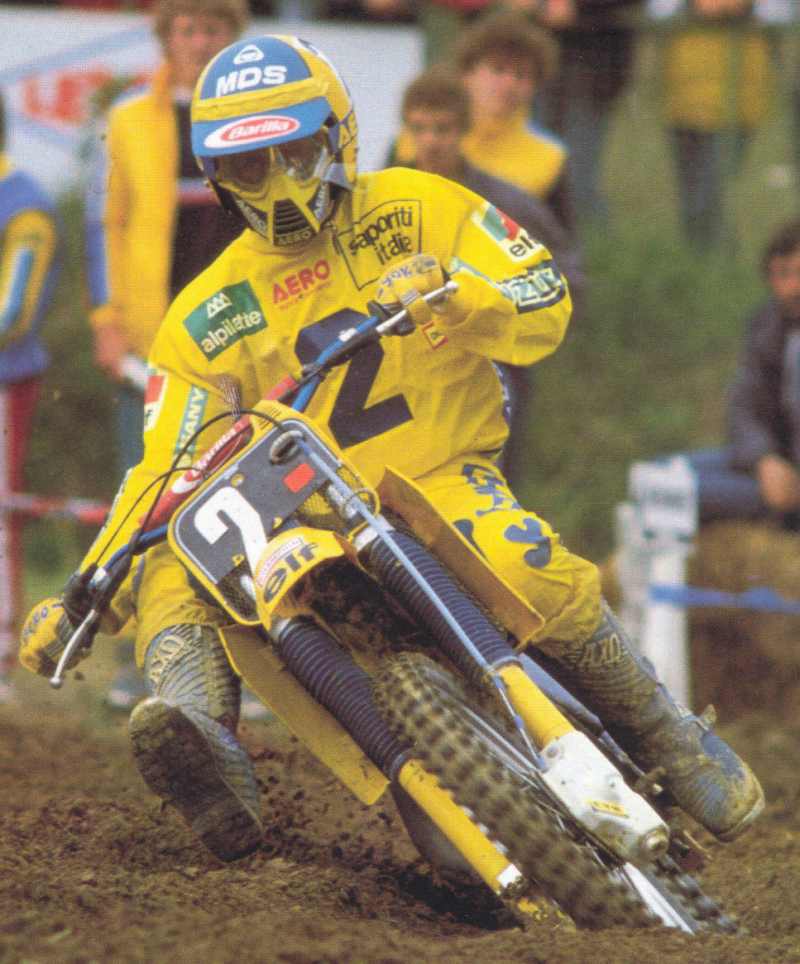 WM 125ccm Cross The 125cc World Championship was set to be a duel between two Italians, but Michele Rinaldi crashed at the opening GP in Vittorio Veneto and had to be taken to hospital with a shoulder injury. He underwent surgery and subsequently missed three GPs. He was back at the start of the fifth GP in Schefflenz, where he scored points and went on to win nine more races. However, Corrado Maddi remained equally alert and maintained his comfortable 30-point lead until the start of the final Grand Prix in Ettelbrück, Luxembourg. In a dramatic season finale, Michele was crowned world champion, Suzuki's tenth world championship title. | |||
WM 500ccm Cross Suzuki officially withdraws from the 500cc World Championship. The decision was based on a combination of economic and strategic considerations. Sales figures for off-road machines fell worldwide. Suzuki has to introduce drastic cost-cutting measures, and its extremely expensive involvement in the 500cc class, in which only expensive factory prototypes are used, is at odds with this. The company wants to concentrate its resources on the smaller classes. | ||||
| 1983 | WM Harry Everts secures Suzuki's last top finish in the 500cc World Championship before the manufacturer's withdrawal. Suzuki leaves the field to its competitors without a fight after setting the pace for a long time with riders such as de Coster. | |||
| 1982 | WM 125ccm Cross Der japanische Ex-Weltmeister Akira Watanabe fährt seine letzte WM-Saison. Ab dem kommenden Jahr wird er sich in Japan als Suzuki Testfahrer, auf die Weiterentwicklung der RH und RM Modelle kümmern. | |||
Erik Geboers setzt die Suzuki Weltmeister Serie in der kleinsten WM Klasse fort. Vor allem ab der Mitte der Saison, wurde er immer stärker und dominierte am Ende klar die Konkurenz. | ||||
| 1981 | WM 125ccm Cross Suzuki signed the experienced Harry Everts to a two-year contract with improved terms for the 125cc class. They did not yet believe the young Geboers was capable of winning the title. Everts, who actually preferred to compete in the 250cc or 500cc class, had to fight hard this season. In the end, however, experience prevailed against the strong competition. | |||
In just his second season, young Eric Geboers had already earned himself a strong reputation. Of course, the advice of his teammate Harry Everts and his brother Sylvain in the Suzuki team had helped him along the way. Now he was ready for the next big step. | ||||
| 1980 | WM 125ccm Cross With six race wins and other top placings, an outstanding Everts Harrysecured his second title in a row. Even a broken hand in the middle of the season couldn't prevent him from winning his third world championship title. However, the factory Suzuki continued to set the benchmark in the paddock in terms of weight and performance. | |||
| 1979 | WM 125ccm Cross Harry Everts came, saw, and conquered. His signing was seen as a changing of the guard in the Belgian press. Three-time world champion and last year's runner-up Rahier left Suzuki to prove that he could become world champion on another bike, and his young compatriot became world champion straight away. After his title in 1975 and some rather difficult years, this was also a great return to the big stage for Harry. | |||
The Suzuki factory RA 125 was equipped with water cooling for the first time. | ||||
| 1978 | 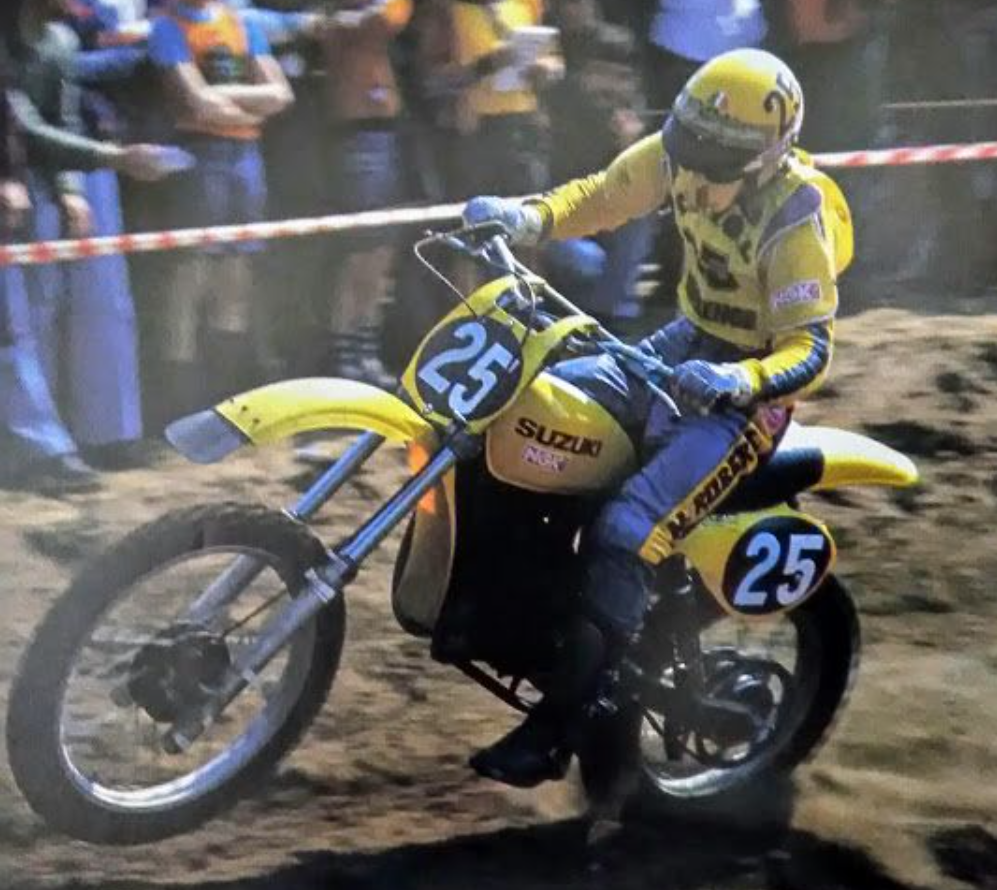 WM 125ccm Cross After his injury last year, Akira Watanabe made an extremely strong comeback. He became the first and so far only Japanese rider to win the Motocross World Championship. | |||
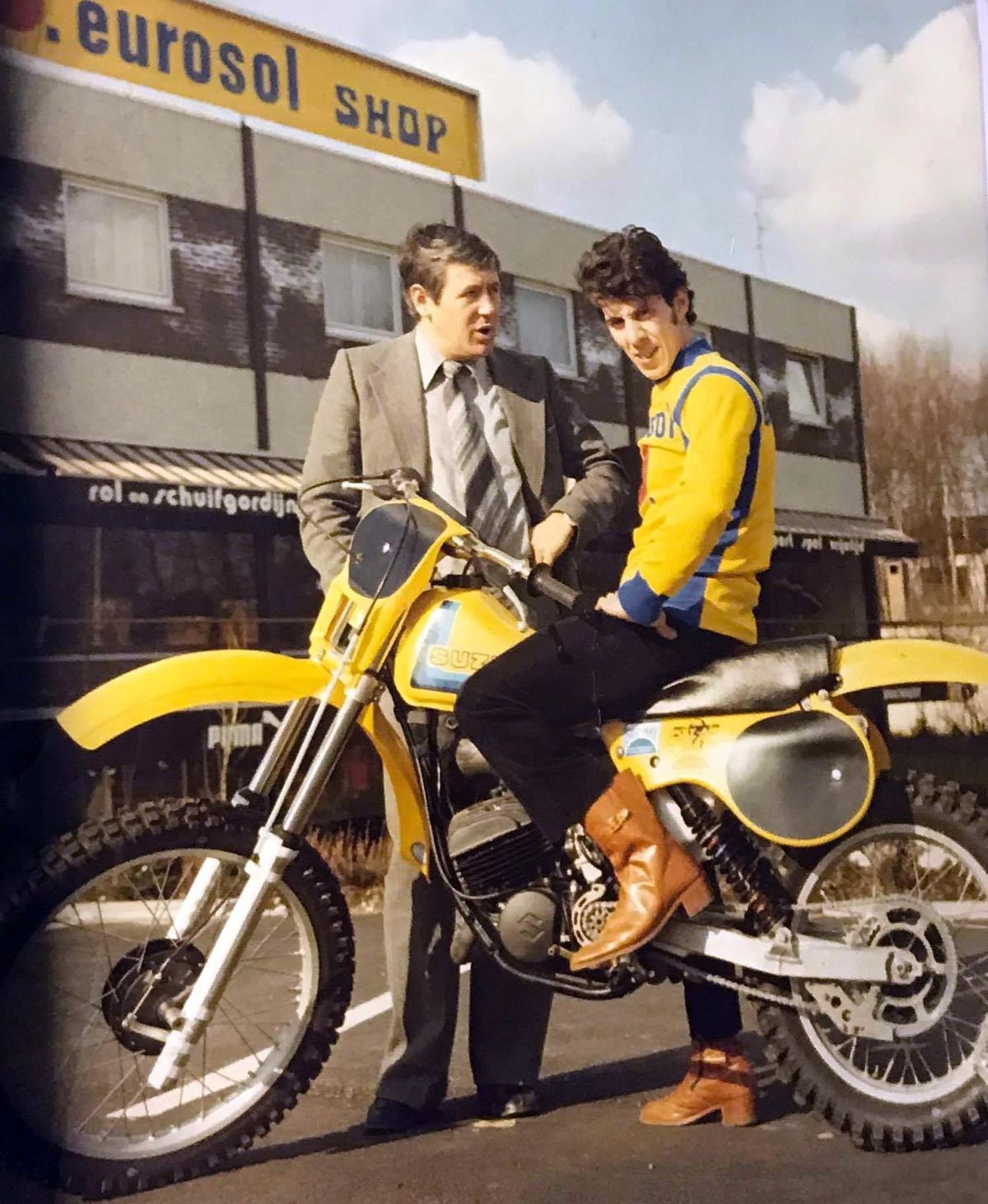 Sylvain Geboers takes over as head of the European Suzuki factory team and signs Harry Everts for the 1979 season. Harry was actually already in Spain to extend his contract with Bultaco. But since he didn't meet Bulto, he flew back to Belgium without having achieved anything. | ||||
| 1977 | 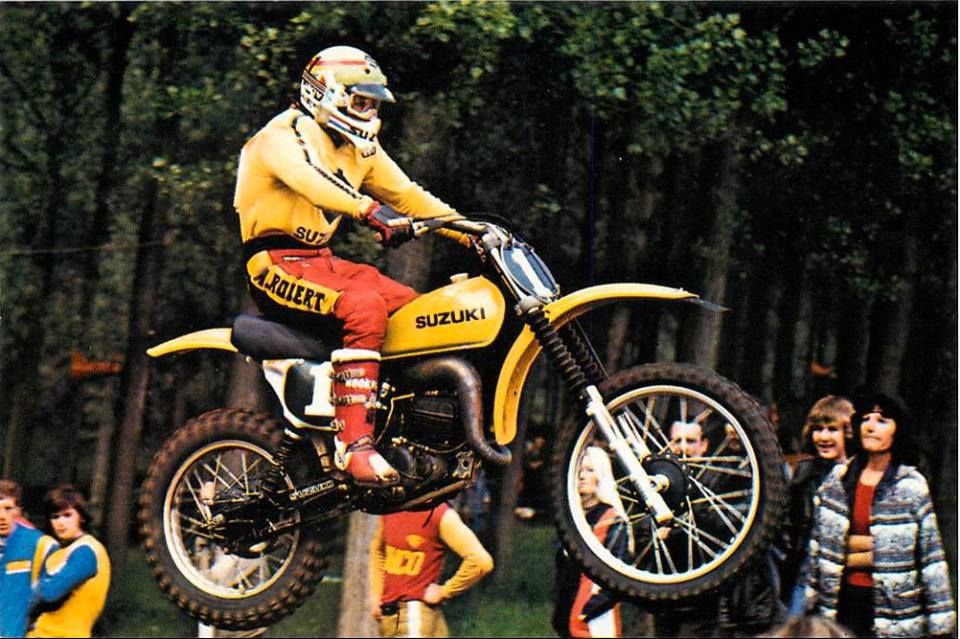 WM 125ccm Cross Gaston and Suzuki continued to set the standard in the 125cc World Championship, even though the RA77 still had to manage without water cooling. | |||
| 1976 | WM 125ccm Cross The Japanese immediately set the standard in the new 125cc World Championship with their factory Suzuki. It was rev-happy, lightweight, and had state-of-the-art chassis technology. Ideal for the small Rahier. With good starts and his consistency, no one could hold a candle to him. | |||
| 1975 | WM Roger de Coster can bring the world championship title back to Suzuki. | |||
| 1973 | 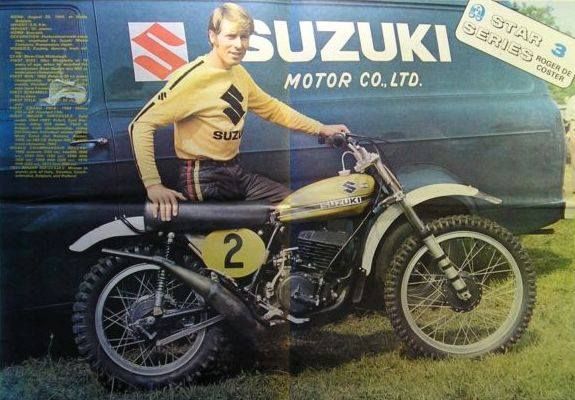 WM 500ccm Cross Suzuki has adapted De Coster's factory 370cc bike to the FIM minimum weight regulations with a new frame and modified weight distribution in order to improve its nervous handling. | |||
Gaston Rahier signs his first factory contract with Suzuki. | ||||
| 1971 | WM 250ccm Cross The 250cc World Championship comprised twelve races that year, and Joël Robert won eight of them. He won the opening race in Sabadell, Spain, right from the start. He clearly dominated the season and was crowned world champion for the fifth time. | |||
Suzuki signs Roger de Coster for the 500cc class. The offer was originally made to Sylvain Geboers, who decided to remain in the 250cc class. | ||||
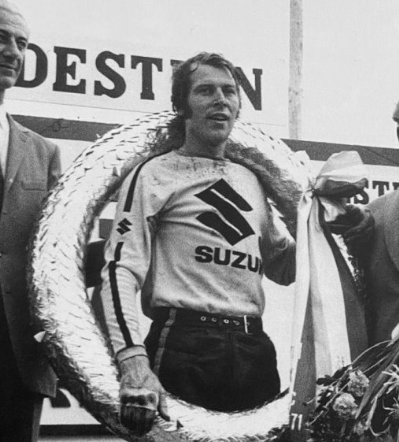 WM 500ccm Cross Roger won his first race on Suzuki at the season opener in Italy. After retiring in Sittendorf, he was able to regain the lead with further victories and defend it until the end. | ||||
| 1970 | WM 250ccm Cross Joel Robert wins Suzuki's first world championship title in motocross | |||
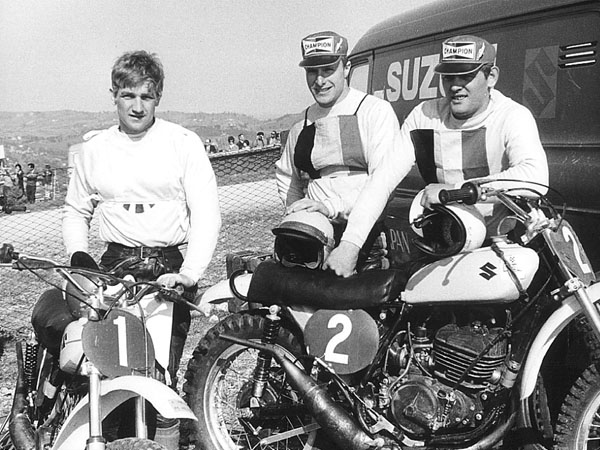 Suzuki is now going all out: for the 1970 season, they have also signed the two leaders of the world championship, Joel Robert and Sylvain Geboers. | ||||
An impressive season for Suzuki. Captured just as impressively in this Suzuki promotional video. | ||||
| 1969 | WM 250ccm Cross The RH69 finally had enough torque and stability. Suzuki was catching up with its role model, CZ. Olle missed the first two races but then had a strong second half of the season with four second places. Third place behind the dominant Belgians Robert and Geboers on their CZs showed that Suzuki was now ready for bigger things. | |||
| 1968 | 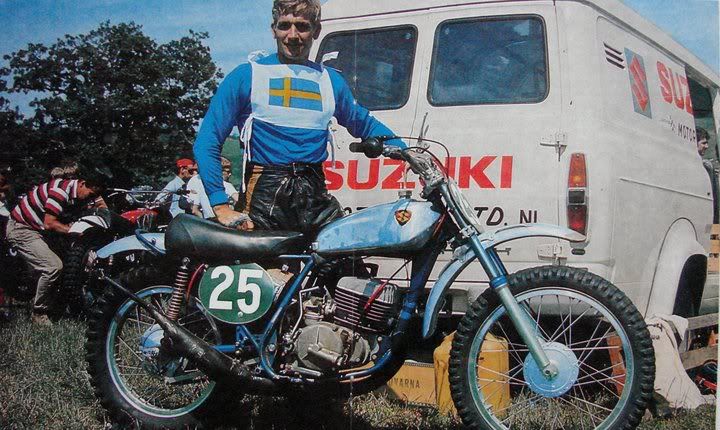 WM 250ccm Cross Suzuki signs two-time Swedish champion Olle Pettersson and becomes the first Japanese manufacturer to enter the Motocross World Championship. He was about to sign with Husqvarna, but chose Suzuki because he was attracted by the role of test and research rider. Like its predecessor, the RH 66, the RH 67 was hopelessly inferior to the European machines. Pettersson actually managed to turn the RH 67 into a usable motocross bike in a very short time. He even finished second in both the Belgian and Dutch Grand Prix. However, a broken leg put him out of action from the middle of the year. | |||
| 1965 | 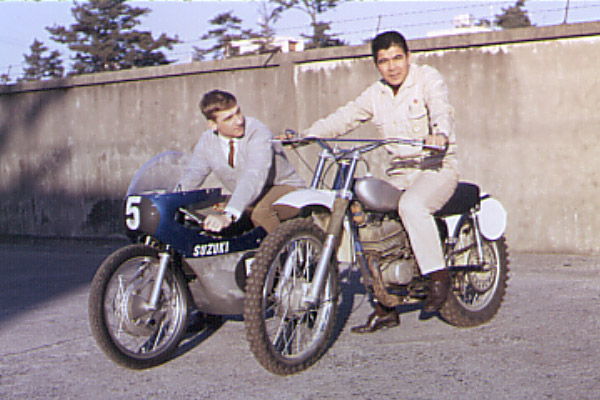 Suzuki launches an official development program for a 250cc motocross motorcycle. As the first Japanese manufacturer, they also venture into Europe. Behind this early foray were R&D manager Okano and racing director Ishikawa, who recognized the potential of motocross. They sent top Japanese rider Kazuo Kubo to Europe. Kubo was actually a successful road racer and member of a team that was considered one of the best in Japan. He was accompanied by engineers (including the often-mentioned Seiichi Suzuki, who also had experience from the Isle of Man TT) to study the conditions there and the technology of the competition. They also took part in two Grand Prix races in Sweden and Finland to assess the situation. | |||
| 1952 | Suzuki's first motorized two-wheeler, a conventional bicycle with a 36 cm³ two-stroke engine. |
Last edited: 2/23/2026 · Jürgen Wißler